

Table of Contents
Whether you’re considering a career change or planning your next step after high school, a business administration diploma prepares you for a range of careers.
You might enjoy working with clients, keeping track of finances, or organizing the people and details that keep a project moving. Business administration gives you several directions to consider, depending on the kind of work you enjoy.
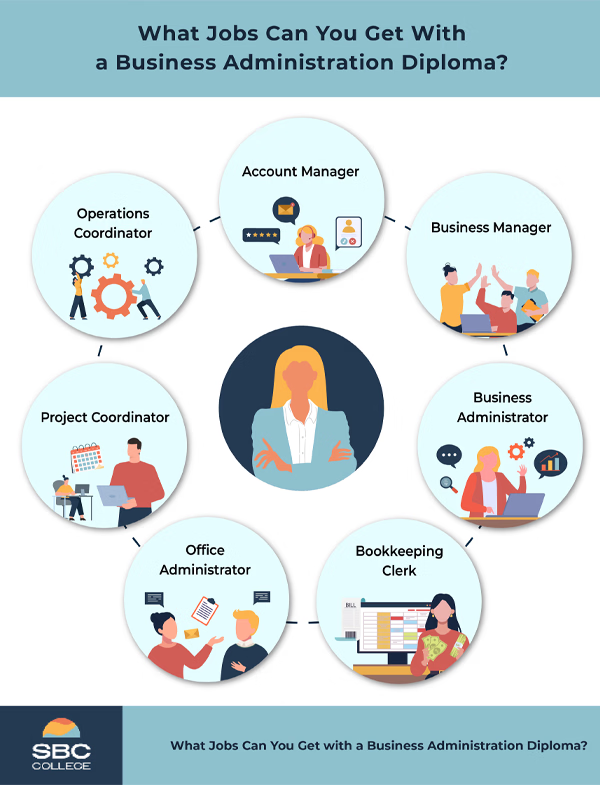
So what could you actually do with the diploma? Here are seven careers to explore, with a look at the work involved and where you could find yourself working.
7 Jobs You Can Get with a Business Administration Diploma

Business Administration training builds both the people skills and the technical knowledge these roles require, from leadership and communication to accounting software and project management. For each role below, you’ll find what the job involves, typical responsibilities, and the skills that help you succeed.
Here are seven roles to explore.
Account Manager
Account Managers build and maintain relationships between a business and its clients. They act as a main point of contact and help clients get the products, services, or support they need.
The role involves understanding client requirements and coordinating with internal teams. Depending on the organization, responsibilities may include:
- Building client relationships
- Answering client questions and addressing concerns
- Coordinating with internal teams to deliver solutions
- Providing product or service support
- Identifying opportunities to offer additional products or services
Strong communication, presentation, and customer relationship skills are important in this role.
Business Manager
Business managers lead teams toward organizational goals. They focus on strategy, decision-making, and communication. They’re also responsible for tracking how a business and its people are performing.
The responsibilities vary depending on the workplace and the size of the organization. They may include:
- Shaping and executing business strategy
- Guiding business decisions using analytics
- Communicating goals, expectations, and decisions to the team
- Solving business problems and workplace challenges
- Supporting employee training and onboarding
- Monitoring team progress and business performance
Leadership, communication, and problem-solving skills are all essential for this role.
Business Administrator
Business administrators make sure the different parts of a business fit and work together. Administrators are the link between departments, equipping each employee with the resources their role needs. By working across teams, they manage processes, tools, and information.
Their responsibilities may include:
- Establishing and improving workflows and processes
- Selecting and managing business tools and software
- Organizing, analyzing, and sharing business data
- Helping the business follow policies, laws, and ethical standards
The role calls for strong organization, communication, and analytical skills. Business administrators should also understand how different departments and teams work together.
Bookkeeping Clerk
Bookkeeping clerks record financial transactions and maintain accurate business records.
Their work helps organizations track income, expenses, and payments. Responsibilities include:
- Recording and organizing financial transactions
- Balancing books and maintaining financial records
- Preparing financial statements
- Tracking accounts payable and accounts receivable
- Using computerized accounting software
- Assisting with payroll or budgeting tasks
Accuracy and attention to detail are important in this role. Employers may also look for experience with accounting software such as Sage 50 or QuickBooks.
Office Administrator
Office administrators coordinate administrative tasks and provide support to employees, management, and customers.
Their responsibilities depend on the organization and the size of its office. Some of the responsibilities include:
- Organizing documents and maintaining records
- Scheduling meetings and appointments
- Managing office supplies and inventory
- Communicating with customers and the public
- Supporting recruitment and employee onboarding
- Coordinating office equipment and resources
- Supervising other administrative staff, where applicable
Office administrators need strong organizational and communication skills. They also need to manage competing priorities and respond to changing workplace needs.
Project Coordinator
Project coordinators support project managers by organizing tasks, helping teams meet deadlines, and tracking and reporting progress.
They keep information accessible and help team members stay informed.
Their responsibilities may include:
- Coordinating resources and team requirements
- Organizing project documents, reports, and contracts
- Assisting with risk management, training materials, and operating procedures
Project coordinators need good time management and communication skills. An understanding of project management tools and processes helps them in this role.
Operations Coordinator
Operations coordinators support the processes that help an organization deliver its products or services. They work with areas such as inventory, logistics, suppliers, and resource management.
Depending on the organization, their responsibilities may include:
- Coordinating vendor and supplier activities
- Monitoring inventory and resource allocation
- Supporting supply chain operations
- Helping implement operational changes
This role requires strong organizational skills, problem-solving, and the capacity to connect many distinct moving parts.
Where Do Business Administration Graduates Work?

Business administration graduates can work in nearly any type of organization. Some of the most common employers are found in:
- Financial services, including banks, investment firms, and credit unions
- Healthcare, including hospitals, insurance agencies, and clinics
- Technology, including software, IT services, and cybersecurity companies
- Retail, including eCommerce sellers, logistics organizations, and merchandising firms
- Professional services, including consultancies, law firms, and recruiters
Other industries that hire business administration graduates include government, nonprofit, and education.
As John S., Business Administration Instructor at SBC College, explains:
“One thing I particularly like about the field is its versatility; the knowledge and skills can be applied to almost any industry, giving you plenty of options as you develop your career.”
Start Your Business Administration Career with SBC College
Which of these seven careers appeals to you most? You don’t have to decide before you start. SBC College’s 47-week Business Administration Diploma program builds skills you can apply across all these roles, giving you room to discover where your strengths and interests fit.
You’ll learn how to:
- Plan and coordinate projects
- Maintain financial records
- Build customer relationships
- Make informed business decisions
You’ll get hands-on experience using industry-standard accounting software, including Sage 50 and QuickBooks, to manage accounts and prepare financial reports, and apply what you’ve learned through a practicum or a capstone project.
The program is taught by industry-experienced instructors who connect what you’re learning to situations you could face at work.
You can study online, taking one course at a time, so you can focus on what you’re learning before moving on to the next subject.
When it’s time to look for work, you’ll have help. With SBC College’s lifetime Career Services, you get help with interview prep, resume writing, and job search strategies – even after graduation.
Frequently Asked Questions About Business Administration Diplomas
What Business Administration skills do employers usually look for?
Employers look for a combination of technical knowledge and interpersonal skills. Communication, problem-solving, and critical thinking are among the most valuable. Other important business administration skills include:
- Time management
- Teamwork
- Adaptability
- Decision-making
- QuickBooks
- Human resources
- Project management
- Office 365 proficiency
How long does a business administration diploma take?
SBC College’s Business Administration Diploma takes just 47 weeks to complete. The program includes a 6-week practicum or capstone project to help you put your skills into practice and covers business operations, accounting, human resources, project management, and communication.
Can I take a business administration diploma online?
Yes. SBC College’s Business Administration Diploma can be completed online. You will also focus on one course at a time, which helps you better retain the information and balance your studies with other responsibilities.
Do I need previous experience to start a Business Administration Diploma?
No. SBC College’s Business Administration Diploma program requires no prior business experience. You’ll build practical skills throughout your courses and apply them through a practicum or a capstone project. You’ll also have support from SBC College’s lifetime Career Services team, including interview prep, resume writing and job search guidance.
Do I need to know math for business administration?
SBC College’s program includes Business Mathematics and Economics Fundamentals.
Basic math is useful when working with financial records and budgets. These courses cover practical calculations and concepts used in business settings.
Can I work during SBC College’s Business Administration Diploma program?
Yes. SBC College’s Business Administration Diploma program is available online. You will study one course at a time, which helps you retain the course material better and balance your work-life and study schedules.